Friday, 15 May 2015

Welcome to my garden


Firstly, I apologise for not blogging for a while.  I've had a maths exam this week, and as usual I was 'cramming' at the last minute.  All done now, and it seemed to go OK.  So, back to baking.  Hurrah!


One of the challenges I've been particularly looking forward to, is making crystallised flowers.  But where to get them?  As Rachel says, you can't use flowers that have been sprayed with chemicals - which probably cuts out most of the ones you'd get in garden centres or florists.  So I thought I'd turn to my own garden.  I really love my outdoor space, and feel lucky to have a good sized garden such as we'd never get with a new build.  Megan is particularly enjoying it at the moment - discovering the joy of being able to toddle around and explore.  On a nice day, she has no need for toys and would happily potter all day.


We don't have many flowers in the  garden, mainly due to a pair of roaming pet rabbits, who eat everything they can.  A couple of years ago, I decided the garden needed brightening up.  So I googled 'plants rabbits hate' and sent Nigel off to Wilko with a shopping list.  He came back with said plants, and we spent a busy afternoon planting pots.  Woke up the next morning, and there was one of the rabbits cheekily sitting on a pot, munching away.  He clearly hadn't read the web page that I did!  So, for the time being the garden will have to stay as it is.  Not that I have much time for gardening anyway!


We are lucky to have 2 apple trees, and I love to see the spring blossom.  It always seems a shame that it's gone so quickly.  So, it seemed a good idea to use it for this challenge.  A way of keeping the spring for a bit longer!  Crystallised flowers are really easy to do.  You just need to paint them with egg white, then sprinkle with caster sugar, and leave to dry overnight.  I made the mistake of painting just the tops!  Checked them in the morning and wondered why they were still soft.  Then I realised, and had to get my egg whites and sugar out again.  The flowers went brown after a few days, and I think maybe that's why - the underside was left open to the air for too long.  They looked gorgeous when they were fresh though - I used them to decorate Rachel's lemon cupcakes...


There are all sorts of edible flowers.  I really like this website, which also gives you some recipes, such as citrus blossom salad and rose petal sorbet.  http://www.thompson-morgan.com/edible-flowers.  It tells you which flowers are edible, and which ones definitely aren't http://www.thompson-morgan.com/poisonous-flower-varieties


If you'd rather not eat raw egg white, I found this link which gives you another method of making the flowers... http://premeditatedleftovers.com/recipes-cooking-tips/how-to-make-candied-flowers/

I'll definitely have a go at crystallised flowers again, but while we've still got the rabbits, I might have to borrow from someone else's garden!  


In other baking adventures, this week I've made Rachel's 'poppy seed cake with vanilla buttercream icing'.  The icing is amazing, and completely unlike any I've made before.  You make a custard with egg yolks; milk and sugar, and then whip it up with softened butter.  Really rich and delicious!  The cake has gone to a friend who's having guests to stay for a family funeral.  I await feedback! 


I've also tried my hand at English muffins.  To form these, you roll the bread dough into a sausage shape and slice 2cm pieces... a bit like making biscuits.  And like my biscuit making attempts, I am hopeless at getting a nice round sausage!  So my muffins were a little misshapen, but tasted good.  I just call them quirky!  I think next time, I'll roll balls of dough and flatten them out.


Gorgeous warm with melting butter, or toasted with cheese under the grill.


Friday, 1 May 2015

Bagels


'If you've never made bagels before, you may be rather surprised to find that they get their dense chewiness from being poached first and then baked.  I make these in an electric food mixer using the dough hook, but you can make them perfectly well by hand too'.
Rachel Allen, 'Bake', p166
 
 
Well, I promised you a bagel challenge and here I am!  They were surprisingly straightforward to make, and I was very happy with the result. Here's how it's done...
 
You will need...
 
  • 450g (1lb) strong white flour
  • 1 x 7g sachet fast-acting yeast
  • 2 level tsp salt
  • 250mls (9fl oz) warm water
  • 2 tbsp runny honey
  • 1 tbsp vegetable oil
  • 3 tbsp treacle or molasses
  • Maize or cornmeal, for sprinkling
  • 1 egg, beaten
  • Sesame seeds; sea salt; poppy seeds or a savoury topping of your choice (optional)
1. Sift the flour and salt into the bowl you plan to make the bread in, add the yeast and mix well.
 
2. Measure the water in a measuring jug, then stir in the honey and oil.  With an electric food mixer on the lowest setting, slowly add all the liquid to the dry ingredients.  Knead on the lowest setting for 10 minutes, checking to make sure the dough is not too wet and adding more flour if it does look too sticky. 
 
3. Turn the dough onto a clean, dry and floured work surface.  Using more flour if necessary, start kneading the dough for 10 minutes.  You may need more flour to avoid getting a sticky dough - you don't want this.  (I actually did carried out this step in my mixer too, just on a higher setting.  It worked well, although my KitchenAid started protesting after about 15 minutes of use and went walkies along the kitchen worktop!)
 
4.Place the dough in a lightly oiled bowl, and turn in the oil to coat.  Cover with cling film or a plastic bag, and put in a warm place for 1-3 hours or until doubled in size. (I put the dough in the fridge overnight, for a slow rise.  It was beautifully aerated the following day...)
 
5. When the dough is nearly ready - doubled in volume - bring a large saucepan of water to the boil (about 4 litres/ 7 pints) and add the treacle or molasses.  Cover and turn off the heat while you shape the bagels. (Even my biggest saucepan wasn't large enough for this, so I used my big stock pot.  I got this from Aldi, and it's proved to be really useful.  I use it for jam making and for large quantites of stew or casseroles.  And now for bagel poaching!)
 
 
Lightly oil 2 baking trays, and sprinkle with maize or cornmeal.  Remove the dough from the bowl, then punch down and knead briefly.  Divide into 7 chunks.  Take one, keeping the others covered with a tea towel.
 
6.  There are 2 ways to shape your bagel.  First, roll each chunk into a 'snake', then bring the ends together and seal with a small amount of water.  Or, roll each chuck into a ball, pierce a hole in the centre and pull the dough open until you can fit your hand inside.  Turn and squeeze, like a steering wheel, to keep it even (I found the second technique easier, I wasn't very good at keeping the 'snake' even as I rolled it along).  There are loads of videos on YouTube if you want to see how it's done.  Place your bagel on the prepared sheet, and make the rest.  Note that the hole will shrink slightly during cooking, so don't worry if it looks a bit too big.
 
7.  Cover and allow to stand for a further 10-20 minutes, for the dough to bounce back.


Here are my shaped bagels, the 'snake' version at the top and 'steering wheel' version at the bottom.
 
 
8. Preheat the oven to 220C/425F/GM7, and heat the saucepan again to a gentle simmer.  Gently lift each bagel into the water and poach up to 3 at a time, for about 1 1/2 minutes on each side.  Remove from the water and allow to drain.  Place on the prepared trays, spacing 3-4 cm apart.  Brush with beaten egg, and add topping if desired.  Bake in the oven for 15 minutes, then turn upside down for a further 10 minutes to cook the bases.
 
 
Et voila!  One batch of bagels, ready in time for lunch. 
 
I enjoyed them in my favourite way, with smoked salmon; cream cheese; a sprinkling of black pepper and some lemon juice.
 
 
Evan had them with jam for his packed lunch the next day, and Nigel enjoyed them with just butter.  For more bagel recipes and topping ideas, I found these websites...
 
 
I'd like to try cinnamon and raisin next.  How about you?!
 
Also this week, I've made Rachel's 'chocolate lava cakes', AKA chocolate fondants.  Was a little nervous as this is what always seems to trip up contestants on cookery shows.  The timing is crucial, too long and they set all through like a sponge cake; not long enough and they disintegrate.  Luckily I wasn't on a cookery show, and had time to watch the oven like a hawk!  We all loved them, especially Megan, who grinned her chocolatey approval!


Friday, 24 April 2015

Brioche & Bacon bread... and bananas along the way!


Well, after all the sweet treats of Easter I thought it was time for a change, and dived into the bread making section of 'Bake'.  Then for some reason, I decided to make Brioche - a sweet, enriched bread,  Oops, my sweet tooth won again!  Still, it was well worth it.  For those who don't know, brioche is a dough with a high butter and egg content - it has a really light texture and golden colour.  


You can buy moulds to shape brioche in the traditional way, like so...


Not my creation, I hasten to add!

As we've been trying to economise a bit, I decided not to buy the moulds, but use the tins I had.  So I used 1 standard loaf  tin, and 4 mini loaf tins.  The latter I bought ages ago, as I thought they were cute (I'm a sucker for cute) and  this was their first outing.  I was pleased with all the results, both in taste and appearance.  The mini loaves sliced perfectly into dinky little slices, which Megan devoured for breaskfast, spread with  butter &  jam.  I think they'd look gorgeous arranged on a cake stand, as part of an afternoon tea. 

Then I did manage a savoury - bacon and cheddar bread.  This is a very easy, hearty loaf, which could be knocked up quickly for those occasions when you've run out of bread and just need something for lunch. 


 I enjoyed it with tomato soup yesterday, and grilled and buttered today. 


Here's the recipe, if you'd like to have a go...

  • 320g (11 1/2oz) plain flour
  • 1 tbsp. baking powder
  • 1/2 tsp salt
  • 1/4 tsp freshly ground black pepper
  • 100g ( 3 1/2ox) Cheddar cheese, grated
  • 100g (3 1/2oz) bacon lardons, cooked until just crisp then cooled
  • 200ml (7fl oz) milk
  • 2 eggs
  • 1 tbsp. wholegrain mustard (I used Dijon as that was all I had)
  • 60ml (2 fl oz) olive oil

  1. Preheat oven to 180C/350F/GM4.  Lightly oil and line the loaf tin with parchment paper.
  2. Sift all the dry ingredients into a large bowl.  Add the grated cheese and lardons.  Mix well,
  3. Pour the milk into a large measuring jug, add the eggs; mustard and olive oil, and whisk to combine.
  4. Make a well in the centre of the dry ingredients and slowly pour in the liquid, stirring all the time until it is fully incorporated, to form a fairly liquid dough.
  5. Pour the mixture into the prepared tin, and bake in the oven for 50 minutes.  Remove from the tin, and cook for a further 10 minutes, directly on the oven shelf to crisp the bottom.  When cooked, it will sound hollow when tapped on the bottom.  Cook on a wire rack before eating.

Rachel also provides variations of pumpkin seed, Gruyere and thyme leaf bread; and sun-dried tomato, rosemary and olive bread.  Will definitely try these at some point!

Over the last week, I've also made 'baked breakfast omelette' with bacon; cheese; mushrooms and herbs.  Really good!


I've also tried Rachel's baked bananas.  Now, it's not very often that a Rachel recipe lets me down, but I was disappointed with these.  We often have baked bananas after a barbecue, left in their skins, wrapped in foil and cooked on the coals.  Rachel's version are peeled and then baked in the oven.  We found that the texture went a bit strange - almost potato like.  I was looking forward to trying her accompaniment of 'orange, honey and mascarpone cream' but also found this a bit strange - more of a liquid than a cream, and the flavours didn't seem to combine very well.  Oh well. you win some you lose some!  
 
Going to attempt bagels next, back soon with the results!


Friday, 17 April 2015

How to joint a chicken... and other tales (vegetarians look away now!)


Jointing a chicken is a skill I've wanted to master for ages.  I've kept hearing how much more economical it is to do this, instead of buying separate chicken pieces.  However, I always imagined it to be really complicated.  Well, making Rachel's chicken and leek pie gave me the perfect excuse to learn.  I trawled the internet, hoping to find a clip of Rachel herself demonstrating - but couldn't.  Instead, I found this old clip of Delia showing how it's done


Slightly off-putting, as she begins by saying that the best way to joint a chicken is to get the butcher to do it for you.  Doesn't inspire confidence!  However, her instructions are clear, and the whole thing much easier than I imagined.  Here's how I did it...
 
 
1.  Make sure you've got a really sharp knife to start with.  Locate the 'parson's nose', as shown here.  Make a cut through this.
 
 
2.  Stand the chicken in a vertical position, and starting with your original cut, slit right down through the backbone.  Open the chicken out flat, like a book, with the skin side down.


3.  Now cut through the breastbone to halve your chicken.
 
4.  Turn your half chicken over, and stretch the legs out with your hands.  You'll see a distinct white line appear in the middle - cut through this to produce a quartered chicken.
 
5.  To divide your chicken into 6, turn over the quartered leg portion.  You'll see an obvious piece of white fat.  Move this aside, and you'll again see a white line.  Cut through this.
 
Hope that makes sense.  If it doesn't, watch Delia! 
 
The chicken pie itself is quite easy.  You cook your chicken portions with stock, wine and herbs and saute some leeks in butter.  A sauce is made from the chicken poaching liquid; cream; and mustard.  The chicken meat is pulled from the bones and mixed into the sauce, with the sautéed leeks.  The mixture is then poured into pie dishes, topped with puff pastry and baked.  It makes a really rich, comforting meal.  I will say that although this recipe uses a whole chicken, you probably don't need to.  You could add extra vegetables to bulk it out, and make for a more economical recipe.  You could also use leftover roast chicken, and this would save a lot of time and effort in preparing the meat.
 
In other escapades, I had a go at Rachel's 'Cherry Crumble Cake'.  I was off to a charity race night - the sort of event where you watch videos of horse races and place your bets.  We were provided with a fish & chip supper, but were allowed to take our own accompaniments.  I wanted to take something fairly 'desert like', but easy to eat with fingers.  This perfectly fitted the bill.  I'll include the recipe here, as I think it's a really useful one, and one which I'm sure I'll make a lot.  I actually replaced the cherries with a portion of stewed apple, which tasted great.  The crumble topping disappeared a bit and lost its crunch - I don't know it this was because of the wetness of the apple.  But I think I'd make a double quantity of topping next time.  Oh, I've also just spotted half a jar of mincemeat in the fridge - I'd like to try this for the filling another time.
 
  • 350g (12oz) stoned cherries (fresh, canned or frozen - not glace)
  • 150g (5oz) self-raising flour
  • Pinch of ground cinnamon
  • 50g (2oz) caster sugar
  • 1 egg
  • 30mls (1fl oz) milk
  • 100g (3 1/2oz) butter, melted
  • Icing sugar, for dusting (optional)
 
For the crumble topping
 
  • 25g (1oz) plain flour
  • 1/4 tsp ground cinnamon
  • 25g (1oz) caster sugar
  • 25g (1oz) butter, cubed
 
  • 20cm (8in) diameter spring-form/loose-bottomed tin
 
  1. Preheat oven to 180C/350F/GM4.  Butter the sides of the cake tin, and line the base with greaseproof paper.
  2. Sift flour and cinnamon into a large bowl, add sugar, mix together and make a well in the centre.
  3. Whisk eggs; milk and melted butter together in another bowl, then pour into the dry ingredients and combine with a wooden spoon or whisk.  Beat well to make a thick, smooth batter, then spoon into cake tin and spread evenly.  Scatter cherries over mixture, and gently press in with the back of a fork.
  4. To make the topping, tip all the ingredients into a bowl.  Rub in the butter with your fingertips to make a crumb-like mixture, then scatter the topping over the cherries.
  5. Bake in the oven for 30-35 minutes, or until the top is lightly golden and a skewer inserted into the middle comes out clean.
  6. Leave in the tin for about 10 minutes, until cool enough to handle, then run a knife around the edge and remove the cake from the tin.  Allow to cool on a wire rack.
  7. Dust with icing sugar if you wish, then serve.
(Sorry, no photos, it was all gobbled up too fast!)


Tuesday, 7 April 2015

Happy Easter!


Hope you've all had a great Easter weekend!  We've had a good one, full of food; fun and family.  My parents stayed for 5 days, which was lovely, and provided plenty of opportunity to try out some new bakes.
 
 
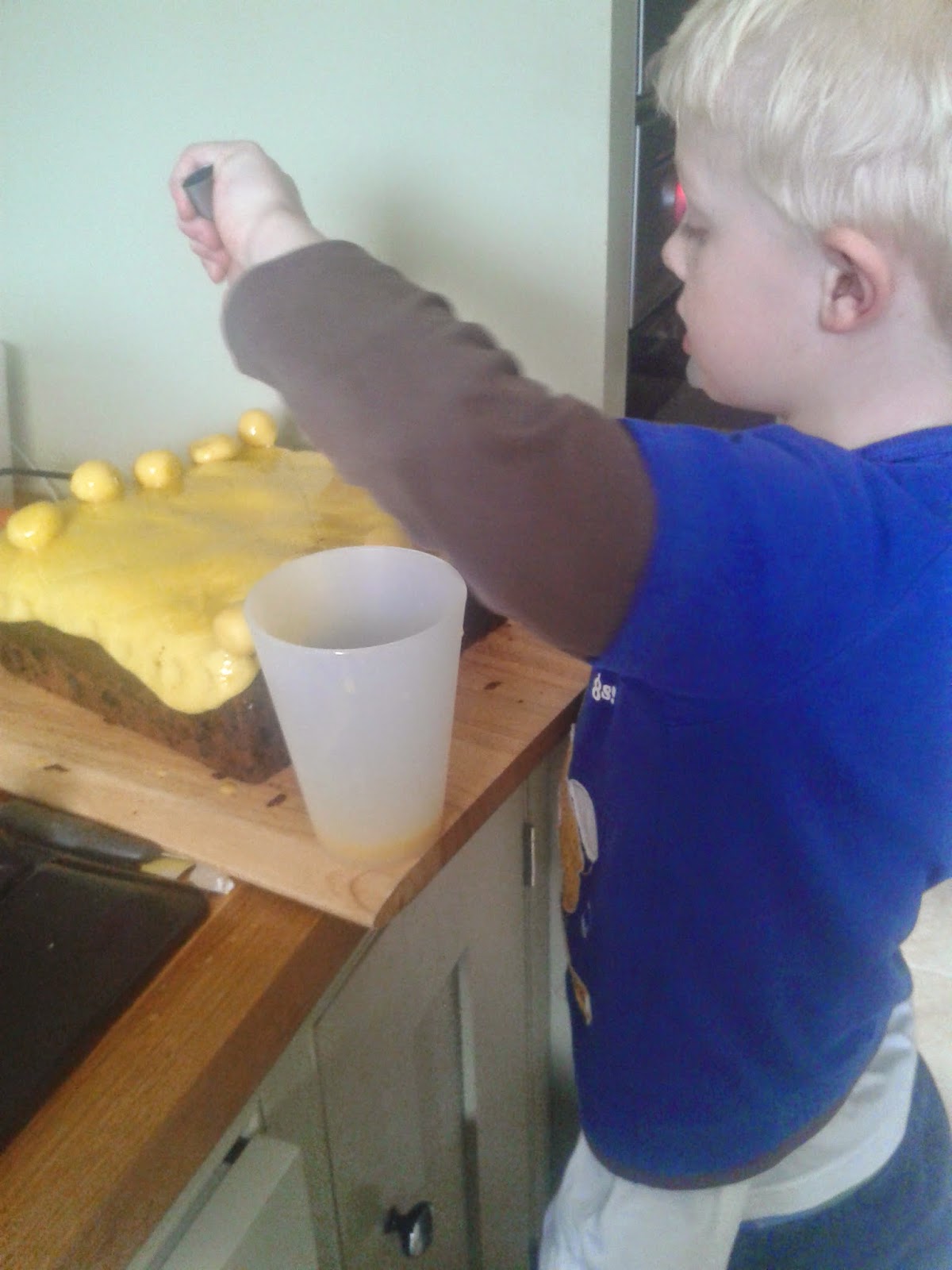
I started by making an Easter Simnel cake, something which I've heard about many times, but never baked or eaten.  It's similar to a Christmas cake, but has a thick layer of marzipan baked into the middle.  You pour half the cake mix into your tin, add the marzipan, and finish with the remaining mix.  It's baked, and then decorated with more marzipan.  The finishing touch is 11 balls of marzipan, arranged around the edge of the cake.  These represent Jesus' 11 disciples, with Judas missing as he was the betrayer.  The marzipan is egg washed, and toasted in the oven to brown.  Now, Rachel doesn't provide a picture of the finished cake, so I did a bit of hunting on the internet.  There seems to be a lot of variation... some are covered top and sides, some just on the top.  There are those decorated with chicks or mini eggs, and those that have stuck to the classic marzipan balls.  I decided just to marzipan the top, with a ribbon around the cake for decoration.  Evan picked a nest of Easter chicks to sit in the middle.  He was keen to help me decorate the cake, which was lovely, and rolled out all 11 balls.  Here he is, concentrating  hard on brushing on the egg wash...


Now, we had a bit of a disaster - when the cake was toasted, the marzipan balls melted and started sliding off the cake.  I have no idea why.  Perhaps the fan oven was a bit fierce?  I was really disappointed, as it looked lovely before that.  Ah well, good job I wasn't on Masterchef or the Bake Off.  Here is the finished cake (don't laugh!)


It did taste nice, and the pieces of hot cooked marzipan which slid off were delicious!  I'll try again next year, maybe lowering the temperature of the oven. 

Of course, we had traditional roast lamb for Easter Sunday lunch.  For afters, I cooked Rachel's 'baked brown sugar custards', AKA crème brulees.  My mum often makes these, and I've kept meaning to have a go.  I was given a kitchen blow torch around the time we got married - nearly 10 years - and believe it or not I've never filled it with gas.  Well, this challenge is all about making me try new things so, off to our local hardware store to fill it up.  The custards are really easy to make - you use a classic custard recipe in which you whisk eggs and sugar, then bring milk and cream to simmering point in a saucepan.  You pour the milk and cream onto the egg/sugar mix, whisking all the time.  The custard is poured into individual ramekins, and baked in a bain marie (water bath).  You can serve the puddings warm, or leave them to cool.  Either way, you sprinkle each with a little soft brown sugar just before serving.  Torch to your heart's content, until the sugar is crunchy.


I'll definitely make these again - they're so easy and can be waiting in the fridge until you need them. 

Easter Monday dinner was Rachel's 'Pork en croute with spiced cabbage stuffing'.  The cabbage is finely shredded, and cooked with cream; coriander; cumin; and mustard.  This gives great flavour to a vegetable which can often be bland.  It's stuffed in to a pork loin which has been split and opened out, and finally wrapped in puff pastry.  We all loved this dish, and it was especially appreciated after a long bank holiday walk/cycle ride.  Again, it didn't look pretty as the pastry split.  Must work on my presentation skills, but until then I'll just enjoy the flavours!


This weekend, I've also revisited Rachel's 'Bakewell bars' (see blog from 18th August 2014).  This time, I made them 'Mr Kipling' style, with icing and cherries on top.


Loved these! The bars were great without the extra topping, but it made a nice change.
 
So that's our Easter weekend!  We all feel as if we've eaten non-stop, and need to lighten up for the next few days!   But I've really enjoyed all the baking, as well as the eating.  I'll finish with one of the highlights of our weekend - Evan had his first turn to look after the school hens.  We had to let them out in the morning, put them to bed at night and top up their food and water.  They provided us with 6 eggs over the weekend, so fresh eggs for Easter breakfast.  They say you really appreciate your food when you know where it comes from, and that's so true.  Those eggs felt very precious, and tasted fantastic.  We're looking forward to our next turn!


Tuesday, 24 March 2015

Megan's first baking lesson


Well, Megan and I had a rare morning in last Thursday, so I decided to have a little baking session.  Megan loves playdough at the moment, so I thought it was a good time to introduce her to the joys of baking.  We tried out Rachel's 'Almond and orange butter fingers'.  Well, Megan had a prod of the dough (note the big fingerprint in the front biscuit!) and then decided to empty the cutlery drawer underneath.  There ended the baking lesson.  Oh well, she's still only 17 months old, and it was fun for the few minutes it lasted!  The biscuits tasted good, very light and crumbly, and with a lovely nutty texture from ground almonds.  I'm not sure what happened with the shaping - Rachel says to roll them into walnut sized balls, then form in to oval shapes.  I presume they are meant to be roughly finger shaped (clue in the recipe name!)  However, mine spread and just joined together in the tin.  Hmmm, not scoring great marks for biscuit shaping so far.  Never mind, as long as they taste good! Here are the finished biscuits:-


On the same day, I made Rachel's brown soda bread.  I really love soda bread, and it brings back some great holiday memories.  In 2002, Nigel and I decided to go camping in Southern Ireland.  I can remember telling an Irish colleague of mine what we were planning. She just looked at me doubtfully.  "Are you sure about that?" she asked.  "There are some very nice youth hostels you could stay in".

"No, we'll be fine!" I replied cheerfully.  Being Welsh, I was quite prepared to put up with a little rain.


Boy, did it rain!  It was sunny on the drive down, and on the drive back.  In between, it poured down. We lived in our waterproofs, and spent a lot of time sheltering in shops and pubs.  On one particular day, we'd gone on a scenic drive - where we could see nothing as it was all shrouded in mist!  We then drove to Dingle Bay, and hung around the harbour waiting for the local dolphin to appear.  It never did, clearly even too wet for sea creatures that day!  We eventually gave up, and took refuge in a cosy pub where we ate big bowls of Irish stew and hunks of soda bread.  Delicious! 


I tried making soda bread after that holiday, but never had much success.  The secret seems to be (having read Rachel's books and watching her programmes), not to knead the dough.  Instead, you keep your hand stiff, like a claw, and gradually work all the ingredients together.  Kneading produces a stiff, inedible lump of dough.  Pleased to say that my bread worked this time, and tasted great. 


It isn't a 'sandwichy' type of bread, but goes well with soup or stews.  It doesn't really keep for more than a day, but after that it makes great toast. 
 
Oh, and a little tip here if you fancy trying soda bread.  You'll need buttermilk, which I don't often have in the fridge and can't buy in my local supermarket.  I found these alternative suggestions on Nigella Lawson's website (www.nigella.com)  You can mix natural yoghurt with milk, at a ratio of 200mls yoghurt to 50mls milk.  Or Greek yogurt can be mixed with equal quantities of milk.  Alternatively, take 250mls milk and stir in 1 tbsp lemon juice or white wine vinegar, to sour.  Leave for 5 minutes before using. 
 
I finished the week by making Rachel's 'Date bread & butter pudding'.  Our church is running an Alpha course at the moment, and we'd been asked to take turns in providing puddings.  A great opportunity for another bake!  I didn't get to try it myself, but I'm assured it went down very well.  It was one of the easiest puddings I've ever made, will definitely try it again soon.


Sunday, 15 March 2015

Shortbread, scones & Yorkshire pud

 
3 very different bakes this week.  To start with, Rachel's 'Oat and vanilla shortbread cookies'.   These were rustled up in a bit of a hurry... I'd been busy making Welsh cakes for St David's Day (this will come in another blog post!)  A few days later, I invited a friend round for a cuppa and cake.  Then realised that Nigel had taken all the Welsh cakes to work.  Oops!  I had a few hours to bake something, from ingredients that I had in the house.  These fitted the bill, and had a lovely crumbly, melt in the mouth texture.  The dough is mixed and then rolled into a sausage shape, refrigerated and sliced into biscuits when chilled.  Here's where I need a bit more practice - I didn't roll it enough and ended up with a flat bottom, so misshapen biscuits.  It didn't affect the taste of course, but maybe I'll try again when I've got more time! 
 
Next, I made spicy bacon & gruyere scones.  No particular occasion, just fancied something different for lunch.  The spiciness comes from cayenne pepper , and really does give an extra 'edge' to the scones.  Oh, I didn't have any Gruyere cheese, so used a mixture of Cheddar and Gouda that was waiting in the freezer.  These were enjoyed by all the family - Nigel and Megan (who I thought would find them too spicy, but really loved them), my parents when I visited for the weekend, and my brother, who loves cheese; bacon and spice, so it was a perfect combination for him.  Oh, Evan was the only one who wasn't keen, but that's no surprise - fussy little monkey!  Sorry about the lack of a photo, the scones were gobbled up before I knew it!
 
Finally, I had a go at Rachel's Yorkshire pudding recipe.  This is certainly nothing new for me.  Back to fuss-monkey Evan, he really loves toad-in-the-hole.  So, we probably have it at some point each week.  I usually make the Yorkshire pud from a Delia Smith recipe.  This uses 75g flour; 1 egg; and a mixture of milk and water.  Rachel's recipe uses 100g flour; 2 eggs; milk and a little melted butter.  It makes for a denser, more 'puddingy' texture, whereas Delia's is more light and crisp.  I like them both.  I thought  I'd share our favourite family recipe - toad in the hole with onion gravy - using Rachel's Yorkshire pudding recipe.  Here goes...
 
Preheat the oven to 200C (180C fan).  You can brown the sausages if you have time - Nigel likes them a bit more crispy so we usually do this.  But it's not essential if you're in a rush!  If you are browning, wait for the oven to come up to temperature, and heat about 1 tbsp oil in a medium sized roasting tin.  Then put your sausages in - 6 to 8 is about right for this Yorkshire pudding recipe.  Let them brown for 15-20 minutes.  If you're skipping the browning stage, put your oil in the roasting tin anyway and give it 5-10 minutes to heat up while you're making the batter.
 
To make the batter, sift 100g (3 1/2oz) flour into a large bowl.  Season, make a well in the centre, and crack in 2 eggs.  Whisk, bringing in the flour from the sides of the bowl, and add 275mls (9fl oz) milk in a steady stream. When it's all mixed, whisk in 15g (1/2 oz) melted butter.  Rachel does suggest putting the batter in the fridge for 30-60 minutes at this stage, to make really light puddings.  I never have time for this though!
 
Take the tin out of the oven, and place on the hob, on a moderate heat - this prevents the oil temperature dropping.  Carefully place in your sausages, if you haven't already.  Then, pour the batter all over.  Place in the oven, and bake for 25-30 minutes, until the sausages are well cooked and the batter puffy and golden.
 
While the toad is cooking, make up your gravy.  I'm really proud of this recipe, as I cobbled it together myself, adding red wine vinegar for flavour.  Then, one day I was watching Masterchef where John Torode was demonstrating his onion gravy method.  He put red wine vinegar in too, although apparently he uses it to help soften the onions.  So, heat some oil in a pan and add 1 sliced onion.  Cook on a gentle heat for about 10 minutes, until soft and golden.  Then, add about 1 tbsp. of red wine vinegar.  When this has been absorbed, add 1 tbsp flour and stir to coat the onions.  Have some beef or vegetable stock ready - about 500mls.  Add a little to the pan, and allow it to absorb.  Continue to add the stock in this way, a little at a time, until it is all used.  If you're cooking potatoes or vegetables to go with the toad, you can use some of the cooking water in the gravy.  Finally, add in a dash of Worcestershire sauce and a splash of mushroom ketchup (if you have any).  Season to taste.
 
Enjoy!
 

Wednesday, 4 March 2015

Happy (belated) birthday blog!


Yes, it is a bit late!  This blog was a year old in January, and I haven't written anything since.  For that, I apologise.  I don't know when life got so busy!  Anyway, my 'new year's resolution' is to try and blog more regularly, hopefully at least once a week. 
 
 
I promise I've been keeping up the baking!  Here's what I've made over the last couple of months:-
  • Naan bread

  • Jammy steamed pudding

  • Corn bread

  • Brown scones with seeds
  • Baked potato, onion and rosemary gratin
  • Calzone

  • Crumpets

  • Baked red lentil dhal
  • Cardamom bread

  • Scheiterhaufen (bread and butter pudding with apple and white chocolate - A-Mazing!)

  • Crème Anglaise
Shout if you want me to write any of the recipes up, otherwise I'll try and fit them in when I have time.
 
Oh, Evan and I attempted to make a gingerbread house just after Christmas - this was to be my showstopper piece to put on the birthday blog post.  We managed to cook the dough and cut the pieces out, then it took about a week to get round to putting it together.  By that time, some of the pieces had crumbled and it just wouldn't stick together.  I got very frustrated, and ended up giving up.  Evan looked crestfallen for a second, until I said he could eat some gingerbread.   I've promised him we'll try again one rainy day! 
 
As for the next year, I have a plan!  I've made 53 recipes out of 139 - I make that 86 recipes to go.  I will complete the challenge, as I hate to be defeated! Most weeks, I'll be making at least 2 recipes to hit my target. Still some big challenges to go, including puff pastry; choux pastry; croissants and doughnuts.  Should be fun! 


Thought I'd tell you about one of my recent challenges, which is Seville orange curd.  I bought a batch of Seville oranges, originally intending to make marmalade again.  However, I saw this at the back of 'Bake' and thought I'd give it a go.  Really pleased with the result - it's deliciously rich and tangy.  I could eat it by the spoonful!  I made 2 batches, and used 1 in an orange meringue pie.  Took this for a church lunch, and it went down really well (thank goodness for church functions - they give me a great opportunity to share my bakes, instead of troughing them all myself!)

So, here's the recipe...

Simply take 150g (5oz) butter; 250g (9oz) caster sugar; the finely grated zest of 1 Seville orange and juice of 3.  Heat altogether, very gently until the butter melts.  Beat 4 eggs and 2 egg yolks together, then stir into the melted butter.  Stir carefully, over a very low heat, until the mixture is thick enough to coat the back of a spoon.  (It's really important to keep the heat low, or you'll get scrambled egg).  If the mixture starts scrambling, push it through a sieve (I did get a few lumps, despite keeping the heat as low as possible.  But a quick sieve sorted it out).  Remove the pan from the heat, and pour into jars. 

I think that's enough for now!  Back soon (I hope) with oat and vanilla shortbread cookies, and bacon and gruyere scones.
 

Thursday, 22 January 2015

Pizza

 
One from before Christmas here... sorry for the delay!
 
Evan really loves pizza, and we tend to have it when we need a quick, no-fuss tea.  However when Megan came along and started her feeding adventure, I had to think again.  Of course frozen pizzas are far too processed and salty for a small baby, so I've been making my own. No, this doesn't please Evan, who would rather have an el cheapo Margarita from the freezer!  He gets very excited when I say it's pizza for tea, then his face falls when he sees me making it... "Oh, Mummy, I don't want homemade!" 
 
 At least Megan and Daddy appreciate my efforts, and as they say, 2 out of 3 ain't bad! 
 
I started with Delia Smith's scone pizza recipe, which is really easy and super-quick.  You just sift 4oz self-raising flour into a bowl, then add 1/2 teaspoon of salt.  Rub in 25g margarine (or I sometimes use butter).  Mix together 2 tbsp milk and 2 tbsp water, and add gradually, to make a soft dough (you may not need all the liquid).  Now, at this point Delia instructs you to roll the dough into a circle.  I don't even bother with that part - instead, I just plonk the dough on a baking tray, and spread it with my hands until it fills it about evenly.  I will add that this recipe makes a fairly small pizza, and we tend to double or even treble the recipe for the 4 of us (perhaps we're just greedy!)
 
This is the pizza sauce recipe I tend to use... http://www.tastebook.com/recipes/3634463--Ultimate-Pizza-Sauce.  It does take a bit of time, but I usually make a large batch and divide it between freezer bags. 
 
Now to Rachel's pizzas!  Yes, they do take a bit more time but are well worth it - they look, and taste, just like an authentic Italian pizza.  They're topped with a fantastic roasted tomato sauce, which is really rich - sort of reminded me of Heinz tomato soup!  I don't really like using tomatoes out of season, but over the summer I'm going to try and make plenty and freeze it.  It will be great to have that summery flavour all winter long!  Rachel gives several ideas for additional toppings - I tried Gruyere cheese, thyme, roasted red onions, chorizo and goats' cheese.  Seriously delicious, although of course, not appreciated by Evan!  The great thing about making these however, is that they're supposed to prepared as individual portions.  So, everybody can choose their own topping, and all are happy!


Wednesday, 7 January 2015

Festive Baking


Hi all, happy new year!  This post feels distinctly un-seasonal now, with the festivities over and all the decorations down.  But Christmas turned out to be such a busy time, I've had no time to update the blog.  Maybe this will inspire you for the future!

I really thought Christmas wasn't going to happen this year... I'm always a bit last minute with the preparations but phew, this was a close call!  Evan was poorly for a fortnight at the beginning of December, with a nasty cold/flu type bug.  I sent him back to school twice, thinking he was better, but by lunchtime he'd crash out again and I'd have a phone call to pick him up.  Bless him, he really went through the mill.  He managed to miss his Christmas concert; disco; and Christmas at the Abbey Pumping Station - one of the highlights of his year.  Happily, he recovered in time for the last week at school and managed to enjoy a pantomime trip and visit from Santa himself.  At this point Nigel came down with the bug, so once again I was tied up doing school runs and trying to keep on top of things at home.  Suddenly, there was a week left to Christmas and I'd hardly done any shopping.  Much as I dislike shopping online, I had to resort to it in the end.  Things finally came together, as they always do, and we had 2 happy little ones who Santa was very good to.  I was very happy that Santa bought me a new laptop, and  hoping this will make my blogging much easier.  I've been using my tablet, and much as I love it in other ways, it doesn't seem to like Blogger.  The text has a tendency to jump about... I'll be typing away and it will suddenly end up in the middle of another sentence.  Plus, it won't seem to upload photos  - it just freezes in the process.  (If anyone is reading this and can tell me why, I'd be very grateful!)  I've had to upload photos from my phone, then go back to the tablet to input text, then back to my phone if I want any more photos.  Total PITA!  Hopefully, things will be a lot easier now.

Well, with all that time stuck at home I did manage to get a fair amount of baking done.  I started at the beginning of December, with some homemade candied peel.  This is something I probably wouldn't have attempted if it wasn't for the blog.  However, I'm glad I did as it's so much better than the shop bought version.  It's really easy - basically you take 5 oranges, 5 lemons and 5 grapefruit (or 15 of 1 fruit).  Cut the fruit in half and juice it, reserving the juice for another purpose.  I made a breakfast juice, although I needed to mix it with a lot of extra orange juice as it was really sharp.  Place the peel in a bowl, sprinkle with a tsp of salt and cover with cold water.  Soak for 24 hours.  You then remove the peel and place in a pan of fresh cold water.   Bring to the boil, and simmer gently for about 3 hours until it's really soft.  Then remove the peel from the pan, scraping out any remaining flesh.  In another large saucepan, dissolve 1.25kg caster sugar in 1 litre water.  Bring to the boil and dissolve the sugar.  Add the peel, and simmer for 30-60 minutes until 'candied'.  Cool slightly, and then place into sterilised jars.  Cover with the remaining syrup.  (I was a little unsure whether to chop the peel at this point - the recipe doesn't say to, but I suppose I'm used to the shop bought stuff.  In the end I left it whole, and it did look lovely in the jars).  Incidentally, I have 3 whole jars of candied peel left.  It's supposed to last about 3 months, so good for a while but not for next Christmas.  I'm not sure what I'm going to do with it so, if you're reading this and you'd like a jar (oh and live fairly close by), you can have one! 


I used the candied peel as the basis for homemade mincemeat, and from there made a few batches of Rachel's mince pies.  Here's where my KitchenAid really comes into its own - I quickly whizzed up 3 batches of shortcrust pastry, and had them all chilling in the fridge, ready for a spare 10 minutes to roll them out.  Here are a couple of the finished articles, warm and dripping with brandy butter.  Yum!


The candied peel also went into my Christmas cake (pictured top).  This is Rachel's variation on the traditional recipe, adding dates; apricots and some crystallised ginger.  She then covers it in homemade almond paste, and toasts it in the oven to add flavour.  I have to admit, it was a bit strange not to cover my cake in the traditional white icing, and Nigel thought it was unfinished.  We've both been enjoying it though!  Bit of a mishap with the cake covering... Rachel says to use half of the almond paste to cover the top of the cake.  I was super efficient, and weighed out exactly half, setting the rest aside.  Covered the top of the cake, no problem.  Then rolled out the paste to cover the sides - well, there didn't seem to be a lot, but I rolled it out thinly and I had just enough.  I wondered how on earth I was supposed to have enough to roll the stars out, but I managed to put some trimmings together and produce 3 very thin stars.  It was only when I was cleaning the kitchen afterwards, that I found the other half of the almond paste sitting in a bowl.  Oops!  On the whole though, I think the cake looked and tasted fine.  I've just been watching 'Rachel's Christmas Bake' on the Sky planner, in which she made this cake.  Delighted to see that mine looked very similar, if a bit lacking in stars!
 
Finally, I had a go at Rachel's stollen recipe.  This is something I always enjoy at Christmas, and have been meaning to make for a while.  It's an enriched bread dough, filled with mixed fruit; more candied peel; rum and spices (black pepper, coriander, cardamom and nutmeg - not a combination I've used in baking before, but a good one!)  After rising, it's rolled out and wrapped around a 'sausage' of marzipan.  It's then left to prove, and baked.  My first batch, unfortunately, was a disaster  It looked great up to the baking stage, but I left it for 40 minutes (as per recipe) and it overcooked.  The fruit tasted burnt and bitter, so there was no salvaging it.  I had a second go, baking it for only 30 minutes - even then it was well done, but tasted good.  (The hazards of having a fan oven I think... I lowered the temperature from 200 to 180C, but there's always a bit of guess work involved in this.  Next time I'll try 160)
 
 
So there you have it, my festive baking.  I've loved having lots of homemade treats around, and hope this will be the start of lots of bake-filled Christmases to come.  I'll try and plan it a bit better next time though - the stolen freezes beautifully so could be made well in advance.  The cake, of course, can be made a while before - and all the better for being drip fed alcohol for a few weeks!  Mince pies freeze well (I freeze them uncooked in the baking tin, and then tip them into freezer bags).  And the candied peel and mincemeat could be made as early as September.  (Mind you, I always say I'll be organised about Christmas and start the preparations early..it never happens.  Watch this space!)